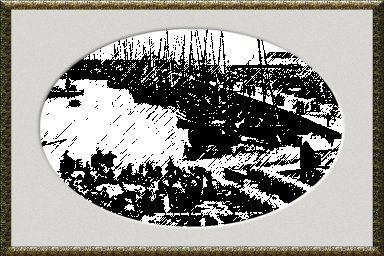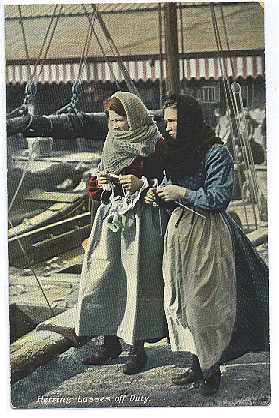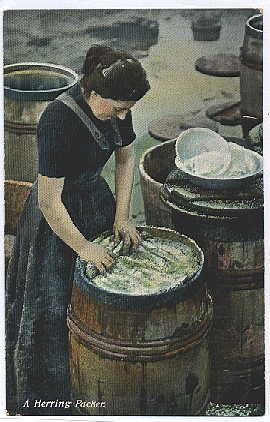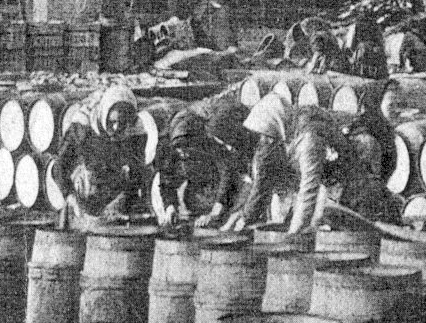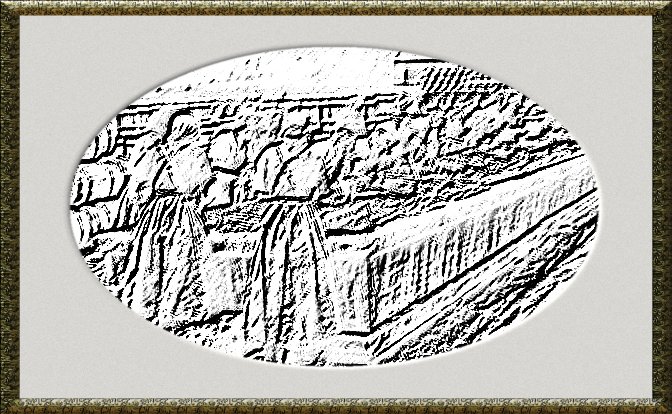
The level of geographic mobility in the working lives of these women was of consequence both in terms of industrial power and domestic power. The annual routine of mobility created moments of power - resistance - not available to their more sedentary sisters.
The web page documents the complexity of this annual routine and the range of resistance to all forms of authority expressed by the herring girls. It is the beginning of an e-museum on the topic.
On line resources for: Routine and resistance - daily struggle and the Scottish herring 'girls'.
The links below provide text and images on the lives and struggles of the Scottish herring girls or lassies as they moved around the coast of Britain (click for map of Scottish coast line )following the fishing to undertake their work of cleaning and gutting fish. Images of women workers as immobile and tied firmly to their local neighbourhoods in pre-suffrage Britain have abounded and rendered invisible the historic mobility and geographic effort of British women workers. Ian Mitchell has recently produced a book chapter which substantially corrects the stereotype of working women's immobility - go to Walking through Scotland's history
Below links to museum holdings and image data bases on the fishing girls are laid out in the pattern of journeying followed traditionally by these women. Some of these resources are skanty whilst some provide powerful images of fishing girls in working dress dancing together in their leisure time: the weight of their labours is evident but their ability to create a festival of pleasure is also evident. Over the next year, materials will be collected in each of these locations. Any information on other sources gratefully received.
On line journeys - Scots 'girls' and the railways.
On line dissertations, theses and e-archives;
Retrospect: On line art galleries celebrating the herring lassies:
The painting of Fisher girls at the farlanes is no longer available at this web address and I have been unable to trace it to a new web address: it was, however, available on this site for a lengthy period and provided a lively, celebratory and vigorous portrayal of fisher girls at their work. It may be that it has now been sold!
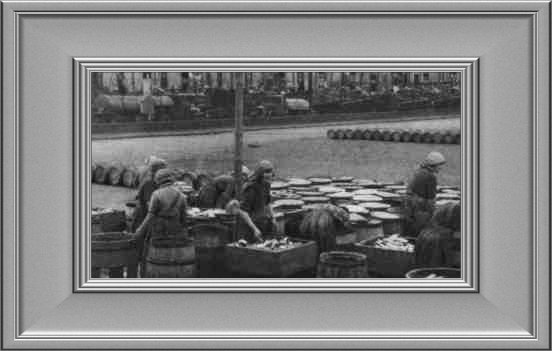
| 'In A World A Wir Ane'- A Shetland Herring Girl's Story
Susan Telford 1 898852 44 8 £7.99 pbk, Re-printed Feb 1999. "The fastest selling Shetland book for a decade, this true narrative details the life of a Scottish Fisher lassie". Shetland Times "This is an excellent book…" Shetland Life, Jan 1999. "Susan Telford offers us a penetrating insight into the life of the herring girls before moving to giving her grandmother's story in the Shetland dialect. But let that not put the reader off. The dialect itself is not impenetrable and is worth taking the effort to appreciate this lively first-hand story of how it was." Books in Scotland, Spring, 1999. |
| Salt in the Blood: The Fishing Communities of Scotland
by Jim Miller ISBN: 0862418364 Subtitle: The Fishing Communities of Scotland Publisher: Canongate Subject: Great britain Subject: Scotland Subject: Fisheries Subject: Great Britain - Scotland Subject: History Subject: Fishing villages Publication Date: 1999 |
| Theresa Tomlinson. THE HERRING GIRLS Published by Red Fox Another story of fisher girls: inspired by the photographs of Frank Meadow Sutcliffe. The herring fleet moved down the North East Coast of England each summer, chasing the herrings South. Scottish fisher girls followed it to work on the gutting and packing. Short-listed for the Sheffield children’s book award.ISBN 0-09-936311-9 |
| Lilian Beckwith Lightly Poached http://www.electricscotland.com/books/lightly_poached.htm This book contains a useful thumbnail sketch of the interaction between Scotland's west coast communities and the 'kipper girls'. |
| Pollock, V.L. 1988, The Sea-fishing Industry in CountyDown 1860-1939, unpub. PhD thesis, University of Ulster. Contains information on the Scottish herring girls involvement in the fish processing at Ardglass in County Down |
| Walking Through Scotland's History (Scotland's Past in Action)
~Ian Mitchell,
NMS Publishing Limited,
Paperback - August 2001 Contains a chapter on women's mobility and its relationship to work. Mitchell captures the role of women in walking and selling fish and in moving over regions following the fishing to be involved in gutting. He also documents the role of women in agricultural ganging in Scotland. |
| Mark Ferguson includes the following references in his on line bibliography on the Newfoundland Fisheries at http://collections.ic.gc.ca/fisheries/biblio.asp: Bochel, Margaret. 1979. The Story of Nairn Fisher Girls at the Gutting. Nairn, Scot.: Nairn Fishertown Museum. (Information from this book has been represented in web form at http://newsarch.rootsweb.com/th/read/SCT-INVERNESS/1999-12/0944301908 Butcher, David R. 1987. Following the Fishing: The Days When Bands of Scots Fisher Girls Followed the Herring Fleets Around Britain. Newton Abbott: Tops'l-David and Charles.
|
| MO BHROGAN URA NicNeill, Catriona A detailed account of the author's upbringing in Barra, and of her working life - as a ‘herring girl', in service, working for the railway - before finally settling in Lowestoft. With twelve photographs. Paperback, 123 pp, Gairm Publications, 1992 ISBN: 1 871901 20 0 Price: £6.60 ($9.31) Book Club Price: £5.61 ($7.91) |
| Chapter 5: Herring lassies, Stromness, Orkney in Barbara Sjoholm, The Pirate Queen: Seal Press, 2004 |
| Jane Webster, School of Archaeological Studies, University of Leicester, Leicester, LE1 7RH, UK Resisting Traditions: Ceramics, Identity, and Consumer Choice in the Outer Hebrides from 1800 to the Present International Journal of Historical Archaeology Publisher: Springer Science+Business Media B.V., Formerly Kluwer Academic Publishers B.V. ISSN: 1092-7697 (Paper) 1573-7748 (Online) DOI: 10.1023/A:1022079315697 Issue: Volume 3, Number 1 Date: March 1999 Pages: 53 - 73 Abstract On a number of levels, peripheral status has been imposed on the Outer Hebrides (Scotland) since the Jacobite Rebellion in 1745. Drawing on a series of interviews with Hebridean families, this paper explores the changing meanings of ceramics imported into the islands from the early nineteenth century and displayed on wooden dressers. It is argued that in renegotiating their identity in the face of a series of externally generated economic changes, rural communities in the Hebrides have acted as thoughtful consumers, appropriating mainland material culture to their own ends. Throughout this process, imports have behaved ambiguously. This ambiguity is crucial to our understanding of the relationship—here characterized not as resistance but as resistant adaptation—between the Hebrides and the mainland. From materials appearing on the web, this article appears to contain some discussion of herring girls and their use of ceramics. |
| For a discussion of the loss of occupational language amongst the 'herring girl community' of East Sutherland go to Discourse
Terralingua Discussion Paper #2 Lexical Loss Among the Final Speakers of an Obsolescent Language: a formerly-fluent speaker and a semi-speaker compared. By Nancy C. Dorian, Bryn Mawr College. |
E-gallery
In constructing this e-archive, there are problems posed by changes on other sites in the web addresses of materials. An attempt will be made to ensure that as addresses change, the new addresses will be located or equivalent new materials will be located in this gallery.
E-movies: herring girls in motion
The BBC has archive film of herring girls at work: go to http://www.bbc.co.uk/nationonfilm/topics/fishing/ to join the herrring girls on the quayside at Great Yarmouth.
'The Prince at Yarmouth' (1930) newsreel footage of the Prince of Wales inspecting the fishing boats at Great Yarmouth, including the sound of the Scots 'fisher girls' singing as they gut the herring @ http://www.movinghistory.ac.uk/archives/ea/collection.html. To view and to listen, however, this footage has to be purchased.
E-song and poetry:
'Singing The Fishing' was a famous radio-ballad series (1957-1964) made for the BBC by Ewan MacColl, Peggy Seeger and Charles Parker. It contains a ballad discussing the journeys and hardships endured by the fisher lassies.
The herring girls by Derick Thomson (in Gaelic and English) page 479 The New Book of Scottish Verse, edited Robert Crawford and Mick Imlah Penguin Books 2001. This poem provides a sharp and poignant characterisation of the routine and resistance of the herring girls in their relationship with the fish curers.
The herring girls had their own relationship to song: Gaelic song, and specific types of Gaelic song, were sung as the herring girls moved from port to port. Click here for more detailed information.
For a short essay note on the poetry of herring 'girls' labour click here.
The transport history of working people: new information communication technology, 'e-vidence networks' and the 'neglected' record.
This site aims to collect records and materials from many directions on the travels and travails of the 'Scotch girls'. The capabilities of the new information communication technology to restore to visibility and ready public access the transport history of Scotland's working people are increasingly apparent. Last year with colleagues I produced the following text (2000):
Secondly, the ability of individuals or groups to share a common cyber space or cyber desk allows for levels of iteration and incremental contribution to knowledge building not readily achievable in a physical environment - 'ten minute activism' is the label already used to describe small inputs made by individuals into campaigns through on line forms, electronic petitions and bulletin boards, 'ten minute contributions to knowledge development' would not be an essentially different concept. The second form of network we are talking about is then a network of knowledge contributors. Imagine for a moment, communities scattered around the sea-board of Scotland wanting to capture and record the history of the herring girls and their travels around the coastline of Scotland before the domestic presence of online technologies - it would have been a very difficult task. Imagine the same task with on-line technologies, family photographs and old letters readily scanned in and developed as personal pages with an 'index' location which groups and displays the total set of links. Indeed, such projects have already begun to develop - the Digital Clubhouse Network (http://www.digiclub.org/) in the United States creates cross generational linkages between older persons and youths where the older persons provide access to their memories and memorabilia of the second world war and the youths record the history for on-line videostreaming and display within a virtual museum.
There are key features of the new knowledge environment which require registration: firstly, whereas historically identifying where knowledge was resourced and archived did not ensure ease of access - difficulties of accessibility and mobility were as great as difficulties of identifying the location of information 'holdings -, in the on line environment, access is relatively simple when the location of 'holding' is known but identifying the relevant locations can be a time consuming business given the proliferation of locations. The range of new information holding options and the healthy proliferation of distinct 'voices' in this on line environment is creating a higher round of network developments - the creation of meta data bases and search engines to sift and sort the environment. This 'indexing' function might be viewed as in some way similar to the boundary management function of discrete repository or depository holdings.
Secondly, globalised information communication technologies and structures enable a readier contact and exploration of the distinct and diverse. It is easier to penetrate the on-line cultural environment than the physical social environment: the normal barriers of social type and social adjacency in respect of exploring the social framework of an alternative view are reduced in their significance. Put in social network terms, reachabilities are transformed. Local action or protest has enriched reachibility characteristics as a consequence of the new information technologies. The cost of globally distributed but parallel protests or knowledge building being coordinated is greatly reduced through the use of web enabling a higher level of effectiveness. " (Extract from Green, Holmes and Grieco, 2000. Archiving social practice: the management of transport boycotts http://www.geocities.com/the_odyssey_group/archivingsocialpractice.html
This year the collection of these materials has begun in this site and links are sought with similar sites be they family, community, occupational or museum sites.
To assist in tracking existing materials, a map of community links produced by Undiscovered Scotland is being used to contact and connect with coastal communities in Scotland who were involved in the processing of herring.
E-discourse: web partners in research
In response to this site, Dr Jurg Meister of Switzerland has provided a short summary on his researches into the occupational dress of the herring girls. Click here for Occupational dress: the herring girls.
E-ssays on the herring girls: framing the evidence
Margaret Grieco has begun organising the web materials collected into articles, the first of these "Routine and resistance: work, spatial mobility and the Scottish herring girls." is available here.
She is currently reviewing visual materials for an essay on: The gutters' huts: occupational place, seasonal domestic space
Netting new evidence?: fish curer's records, a preliminary signposting
The payment structure of the mass seasonal migration of female fish gutting and packing labour is unresearched. The frequency with which oral accounts and the fragments of written account refer to the workgroup of three (two gutters and a packer) as the keystone structure of this flexible industrial workforce is likely to have its counterpart within the records of the fish merchants and curers. This short section provides an identification of the location of fish curer and merchant records which could potentially fill in some of the missing detail of the longstanding practice of herring girl migration:
Netting new evidence?: Young Women's Christian Association records held at Warwick University
Netting new evidence?: Government records on line
Publisher: HMSO
Date published: 1932
Short title: Fishing industry: report
Corporate author: Committee of the Economic Advisory Council
Personal author: Duncan; Hall; Holland-Martin; Murray; Pole; Scott
Chairman: Scott, W.
Contains tables on:
Fish as women's work: contemporary patterns
E-vidence from the developing world
Women's travel and labour history: companion sites
Women's labour history has largely been underwritten and under-recorded, most particularly, those sources of women's historic employment which involved transport and travel. The herring girls' history provided one source of challenge to sedentary accounts of women's occupational existence. Hopping or hop-picking provides another: for a site which reports on women's labour in the hopfields of Kent and Hampshire, U.K and the hopfields of New York State, USA click here.